AI Agents for Small Business UK: What They Are and How to Use Them
Leanne runs a letting agency in Stockport with four staff. She set up what her tech supplier called an "AI agent" to handle tenant maintenance requests. For the first three days, it worked beautifully: acknowledging requests, categorising urgency, notifying the right contractor. On day four, it booked two emergency plumbers to the same property, sent a rent arrears notice to a tenant who had paid on time, and created 14 duplicate entries in her CRM. The agent was doing exactly what it was told. The problem was that nobody had told it enough.
Leanne's experience is increasingly common. AI agents for small business UK owners are adopting in 2026 represent the biggest shift in business automation since cloud computing, but the gap between the marketing pitch and the reality is wide enough to lose money in. Gartner predicts that 40% of enterprise applications will feature task-specific AI agents by 2026, up from less than 5% in 2025. UK small business AI adoption has jumped from 6.3% to 8.8% in just six months. The wave is coming. The question is whether you ride it or get swept under it.
This guide explains what AI agents actually are, which ones work for businesses with 1 to 20 staff, what they cost, and how to deploy them without creating Leanne's nightmare. Want to skip ahead and find out which AI agents would work in your business? Our AI Assessment at £499 maps your workflows and identifies the exact automation opportunities, with a money-back guarantee if we cannot find at least five hours of weekly savings.
What AI agents actually are (and why they matter)
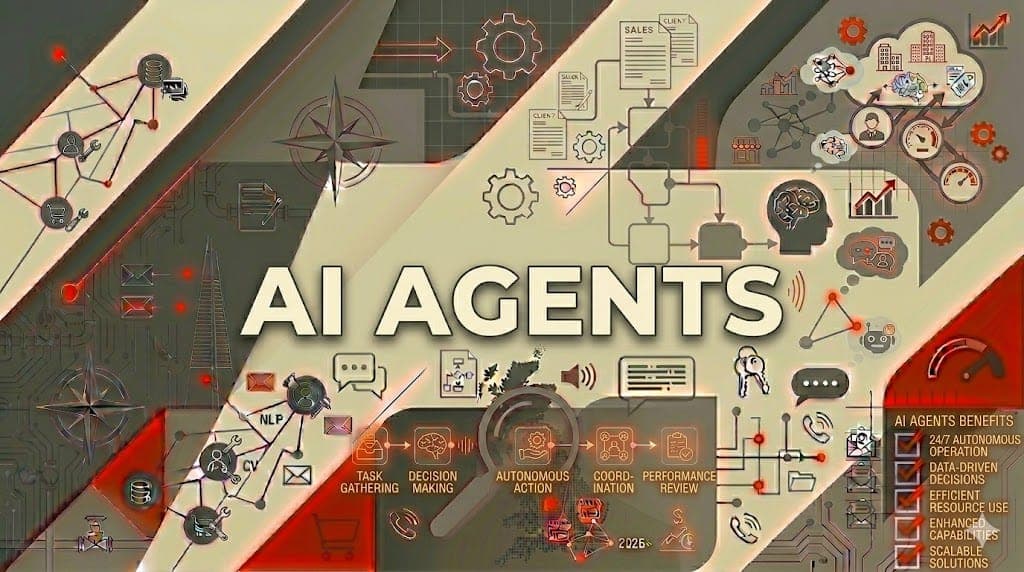
Most small business owners have used AI chatbots. You type a question, it gives an answer. An AI agent is fundamentally different. Instead of waiting for your input, it takes action autonomously. It plans, executes, and completes multi-step workflows with minimal human intervention.
Think of the difference this way:
| AI Chatbot | AI Agent | |
|---|---|---|
| Trigger | You ask a question | An event triggers it (email arrives, form submitted, deadline reached) |
| Capability | Answers with text | Takes actions: sends emails, updates databases, books appointments, creates documents |
| Scope | One response at a time | Multi-step workflows across multiple tools |
| Learning | Follows fixed scripts | Adapts based on context, previous actions, and outcomes |
| Supervision | Fully supervised | Semi-autonomous to fully autonomous |
A chatbot tells you the answer. An AI agent does the work. That distinction matters because the tasks eating your time are not questions that need answering. They are repetitive workflows that need executing: chasing invoices, routing enquiries, categorising expenses, scheduling appointments, following up on quotes.
AI agents for small business UK companies are deploying right now handle exactly these tasks. They connect to your existing tools, using platforms like Zapier or Make.com as the connective tissue, and execute workflows that previously required a person clicking through three or four different applications.
Five AI agents UK small businesses are using right now
Here are concrete examples of agentic AI for SMEs, drawn from what we see working in UK businesses with 1 to 20 staff.
1. Lead qualification and follow-up agent
What it does: When a new enquiry comes in, by email, web form, or phone, the agent captures the details, qualifies the lead based on your criteria (budget, location, service needed), sends a personalised acknowledgement, and either books a call or adds them to your follow-up sequence.
Who uses it: Trades businesses losing jobs to unanswered calls. Our guide on AI phone answering services covers the phone-specific angle.
Time saved: 5 to 10 hours per week for a busy trades firm.
Tools: Zapier + CRM (HubSpot, Pipedrive) + email automation. For phone-based leads, a dedicated AI answering service like ARROW or No Missed Calls.
2. Bookkeeping and expense categorisation agent
What it does: Monitors your bank feeds and incoming receipts. Automatically categorises transactions, matches receipts to payments, flags anomalies, and prepares reconciliation summaries for your accountant.
Who uses it: Any small business drowning in receipts and bank reconciliation. Particularly valuable for accountants managing multiple client books.
Time saved: 8 to 12 hours per month. QuickBooks' own research suggests their AI features save SMBs up to 12 hours monthly on bookkeeping tasks.
Tools: Dext + Xero AI or QuickBooks AI. Layer Make.com on top for custom categorisation rules.
3. Tenant communication and maintenance triage agent
What it does: Receives maintenance requests from tenants via WhatsApp, email, or web form. Categorises by urgency. Sends troubleshooting guides for simple issues. Routes genuine jobs to the right contractor with full details. Follows up with the tenant after completion.
Who uses it: Property management firms and letting agents. See our deep dive on automating maintenance requests for the full implementation guide.
Time saved: 6 to 9 hours per week for a portfolio of 100+ units.
Tools: askporter or Lanten for the AI triage layer, connected to your property management software via API or Zapier.
4. Document processing and compliance agent
What it does: Reads incoming documents, such as contracts, invoices, and compliance certificates, extracts key data, checks against your requirements, flags missing items, and files everything in the right place.
Who uses it: Accounting practices handling client tax documents, builders managing subcontractor CIS certificates, property managers processing tenancy agreements.
Time saved: 3 to 5 hours per week depending on document volume.
Tools: Custom AI assistant trained on your document types + cloud storage integration.
5. Quote follow-up and sales pipeline agent
What it does: After you send a quote, the agent monitors for responses. If no response within your set timeframe (say 48 hours), it sends a personalised follow-up. It tracks which quotes are accepted, declined, or stale, and updates your pipeline automatically.
Who uses it: Trades businesses and service companies. Read our guide on automating quote follow-ups for the specific workflow.
Time saved: 3 to 6 hours per week for a business sending 20+ quotes per month.
Tools: CRM + Zapier or Make.com + email automation.
How to choose the right AI agent for your business
Not every task needs an autonomous AI agent. Some tasks are better handled by simpler automation or by humans. Here is a decision framework for small business AI tools UK owners can use:
Use an AI agent when:
- The task is repetitive and follows consistent patterns
- It involves multiple steps across multiple tools
- Speed of response matters (leads, maintenance requests, customer queries)
- The consequences of a mistake are low or easily reversible
- The task currently takes more than 5 hours per week
Use simpler automation when:
- The task is a single step (sending a notification, updating a field)
- It does not require judgement or context
- A simple Zapier workflow or email rule handles it
Keep it human when:
- The task requires relationship-building or emotional intelligence
- Mistakes could have serious financial or legal consequences
- The situation is genuinely novel each time
- Your clients specifically value human interaction for this task
The AI savings calculator can help you estimate the return on automating specific workflows.
Setting up AI agents without breaking your workflows
Leanne's disaster happened because she skipped the boring part: defining exactly what the agent should and should not do. Here is how to avoid the same fate with AI automation agents UK businesses can trust.
Step 1: Document the workflow manually first
Before any automation, write down every step of the process you want to automate. Include decision points ("if the request mentions gas, escalate immediately"), exceptions ("if the tenant's lease expires within 30 days, flag for review"), and failure modes ("if the contractor does not respond within 2 hours, try the backup").
If you cannot describe the workflow on paper, an AI agent cannot execute it reliably.
Step 2: Start with a single workflow
Do not try to automate five things at once. Pick the workflow that is most repetitive, has the clearest rules, and where a mistake would cause the least damage. For most small businesses, that is lead acknowledgement or expense categorisation.
Step 3: Build with guardrails
Every agent needs boundaries. Set limits on what it can do without human approval. A lead qualification agent should not promise pricing. A maintenance agent should not authorise payments. A document agent should flag uncertainties rather than guess.
Marcus runs a building firm in Reading. He set up a quote follow-up agent with a simple rule: the agent can send two follow-up messages with pre-approved copy, but any personalised response from the client gets routed to Marcus. "The agent handles the chasing. I handle the conversations. It works because neither of us does the other's job."
Step 4: Test with real data, small scale
Run the agent alongside your normal process for two weeks. Compare its outputs to what a human would have done. Track accuracy, response times, and any errors. Only expand the agent's scope after you are confident it handles edge cases correctly.
Step 5: Monitor continuously
AI agents are not set-and-forget. Review their activity weekly for the first month, then monthly. Check for drift, where the agent's behaviour gradually moves away from your intention, and for edge cases you did not anticipate.
What AI agents cost for UK small businesses
Pricing varies widely depending on complexity. Here is a realistic breakdown of autonomous AI for business tools at the small business level:
| Solution Type | Monthly Cost | Best For |
|---|---|---|
| Pre-built agents (Zapier, Make.com) | £20-£80 | Simple, multi-step workflows |
| AI-enhanced software (Xero AI, QuickBooks AI, Dext) | £15-£50 per tool | Industry-specific tasks with AI built in |
| Custom AI agents (HeyBRB agent builds) | £500-£2,000 one-off + £50-£200/mo | Complex, business-specific workflows |
| Platform agents (Salesforce Agentforce, Microsoft Copilot) | £200-£500/mo | Businesses already on these platforms |
For most small businesses with 1 to 20 staff, the sweet spot is pre-built agents on Zapier or Make.com (£20 to £80 per month) combined with AI features in your existing software. That gives you 80% of the benefit at 10% of the cost of a custom build.
Custom AI agent builds make sense when your workflow is genuinely unique, when you need tight integration between multiple systems, or when the volume justifies the investment. A letting agency processing 500 maintenance requests per month will get more value from a custom agent than one handling 20.
The best way to know which approach fits your business: book an AI Assessment and get a custom automation roadmap with specific tool recommendations and expected savings.
What can go wrong (and how to avoid it)
Honesty about failure modes is more useful than hype. Here are the common ways AI agents go wrong in small businesses:
Data quality issues: AI agents are only as good as the data they work with. If your CRM has duplicate contacts, inconsistent naming, or outdated information, the agent will amplify those problems. Clean your data before deploying an agent.
Over-automation: Automating a broken process does not fix it. It makes it break faster. If your quote follow-up process has unclear ownership or your maintenance workflow has undefined escalation paths, fix the process first.
Insufficient guardrails: The CRM disaster mentioned in developer forums where an agent created hundreds of duplicate records happened because there were no deduplication checks built in. Every agent needs rules about what it cannot do, not just what it can.
Ignoring UK GDPR: Autonomous AI for business that processes personal data must comply with UK GDPR. If your agent categorises customers, scores leads, or makes decisions affecting individuals, you need a lawful basis, transparency notices, and the ability for individuals to opt out. The ICO is increasingly scrutinising automated decision-making.
Abandoning human oversight: The point of AI agents is to handle routine work so humans can focus on high-value tasks. The point is never to remove human oversight entirely. Build review checkpoints into every agent workflow.
Frequently asked questions
What is the difference between AI agents and AI chatbots?
A chatbot responds to your questions with text. An AI agent takes autonomous action: it sends emails, updates databases, schedules appointments, and executes multi-step workflows across your business tools. Think of a chatbot as a reference librarian and an agent as a virtual assistant who actually does the work.
Are AI agents safe for small businesses to use?
Yes, with proper setup. Start small, set clear boundaries on what the agent can do without approval, test thoroughly before expanding, and monitor activity regularly. The risks come from poor implementation, not from the technology itself.
Do I need technical skills to set up AI agents?
For pre-built agents on Zapier or Make.com, no. These platforms use visual, drag-and-drop builders. For custom AI agents with complex logic, you will need either technical help or a specialist like HeyBRB to build the agent for you. Our no-code automation service handles the middle ground.
How long does it take to see results from AI agents?
Simple agents (lead acknowledgement, basic follow-ups) can be live within a day and showing results within a week. Complex agents (document processing, multi-system workflows) typically take 2 to 4 weeks to set up and test. Most businesses see measurable time savings within the first month.
Will AI agents replace my staff?
No. AI agents replace repetitive tasks, not people. The time your staff saves on routine work gets redirected to higher-value activities: client relationships, complex problem-solving, business development. The businesses getting the most from small business AI tools UK-wide are the ones that redeploy staff time rather than cut headcount.
Your competitors are already building their AI team
The businesses winning work in 2026 are not necessarily the biggest or the best-funded. They are the ones that respond fastest, follow up consistently, and never let a lead or a task fall through the cracks. AI agents for small business UK companies are deploying make that possible without adding staff.
You do not need to automate everything. You need to automate the right things: the repetitive, time-consuming workflows that currently eat your team's best hours. Start with one agent, prove the value, then expand.
Book an AI Assessment for £499 and get a custom roadmap showing exactly which AI agents would work in your business, what they would cost, and how much time they would save. If we cannot find at least five hours of weekly savings, you get a full refund.
Not ready for that yet? Start with our free AI audit to see where your biggest automation opportunities are.
The question is not whether your business will use AI agents. It is whether you will be the one setting them up, or the competitor who got there first.