75% of UK small business owners have tried AI. They're still losing 10 working weeks a year to admin.
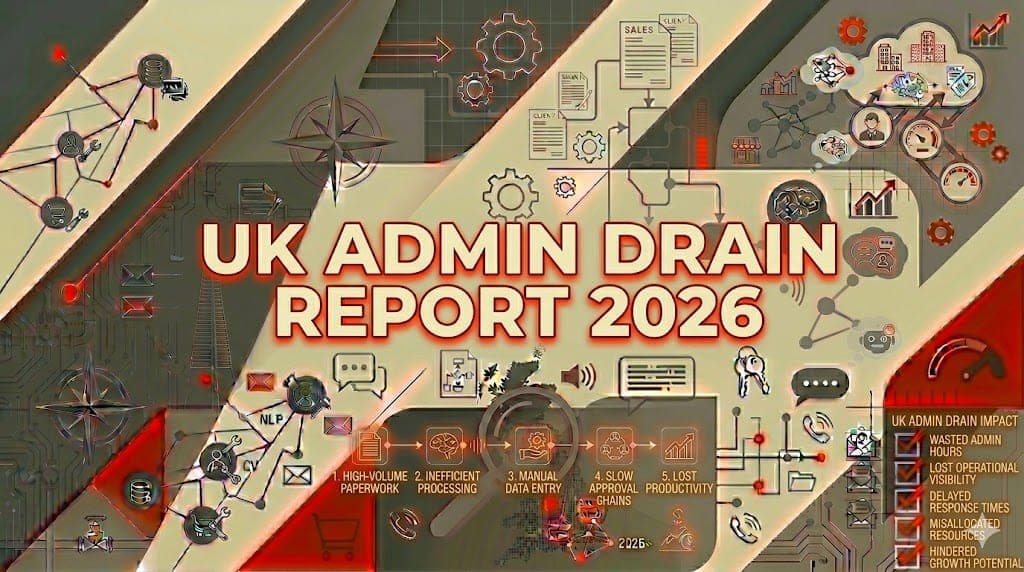
384 hours a year on admin. And 83% of UK business owners have no idea what it costs them.
We surveyed 167 UK small business owners in March 2026 and asked them about admin: how much time it takes, when they do it, whether they've tried to fix it, and what happened when they did. The full findings are published in our UK Admin Drain Report 2026.
The headline number is 8 hours per week. That's the average time spent on repetitive admin tasks that the owner knows, in theory, could be handled differently. Over a year, that's 384 hours. Ten full working weeks. And here's the thing that stopped me when I first ran the numbers: 83% of respondents have never once calculated what that time is costing their business. Not roughly, not on the back of a napkin, not in any way at all. 38% don't even have a vague figure in mind.
Think about that for a second. If a pipe was leaking in your building and costing you £20,000 a year in water damage, you'd find it, measure it, and fix it. But when the leak is invisible, when it's measured in hours instead of litres, it gets absorbed into the rhythm of the week. Tuesday evening answering tenant emails becomes normal. Sunday morning invoicing becomes just "what you do." The leak continues because nobody ever puts a bucket under it.
This article breaks down the findings from that report, adds context from the raw data that didn't make it into the three-page summary, and tries to make sense of what I think is the most interesting tension in the results: UK business owners are clearly aware of AI tools, they've mostly tried them, and they're still drowning in admin.
The time isn't disappearing during office hours
The first thing that jumps out is when admin actually gets done. Almost half (46%) of the respondents do their admin in the evenings, after business hours. A quarter do it at weekends. 41% said their admin eats into time they should be spending on growth activities like sales, marketing, or business development.
This matters because it reframes the problem. The conventional story says admin is an efficiency issue: you're doing something slowly that could be done faster. The data tells a different story. Admin isn't making the workday longer. It's making life worse. It's what you do after the kids go to bed, or before the day starts, or in that dead gap between jobs when you should be thinking about next quarter.
I've spoken to hundreds of small business owners over the past year, and this tracks perfectly with what I hear on discovery calls. The letting agent isn't writing tenant response emails during working hours because working hours are taken up with viewings, maintenance calls, and landlord queries. Admin gets done when the "real work" stops. Which means the work never actually stops.
There's a compounding effect here that the headline stats don't capture. When you do admin at 9pm, you're not just losing an hour. You're losing it at the worst possible time, when your concentration is lowest, when mistakes are most likely, and when the opportunity cost is your relationship with your family or your own rest. An hour of admin at 9pm costs more than an hour of admin at 2pm, and the survey can't measure that difference. But anyone who's chased an invoice at their kitchen table after dinner knows it's real.
You can see the consequence in the free-text responses. When we asked what people would do if they got those 8 hours back, the top answer wasn't "grow the business" or "take on more clients." 50% said they'd spend more time on the work they actually enjoy. 49% said they'd work fewer hours and have a better work-life balance. The third-most popular answer, at 41%, was investing in growth.
That ordering matters. People want relief before they want growth. The admin is corrosive. It grinds people down. And when the trade press runs stories about productivity tools, the framing is almost always "grow your business faster." The survey says something different. The first thing most owners want is to stop working at 9pm.
£50 a month on software while losing ten working weeks
One of the starkest findings in the report is the disconnect between how much time owners lose and how much they spend trying to fix it. 54% of respondents spend under £50 per month on business software. That's everything: accounting, CRM, scheduling, communication, project management. The whole lot, for less than the cost of a few takeaway coffees a week.
I'm not suggesting that spending more money automatically solves the problem. Plenty of businesses burn through expensive software subscriptions and still drown in admin because the tools don't match their workflows. But the scale of the gap is worth sitting with. You have business owners losing ten working weeks a year, and more than half of them have a total software budget under £50 per month.
To put that in perspective: Xero's cheapest plan is £15/month. Add a basic CRM at £12. That's already £27 before you've paid for a scheduling tool, an email platform, or anything else. These are businesses running on the absolute minimum tech stack. Several respondents mentioned using WhatsApp groups and Google Sheets as their primary business systems. That's not unusual in this market. It's the norm.
The obvious question: is it that they don't know better tools exist, or that they don't believe those tools would work for them specifically?
The survey data points toward the second explanation. 47% of respondents have never tried to automate any admin task at all. But when you dig into why, the reasons aren't what you'd expect. It isn't cost. And for three-quarters of them, it isn't ignorance about AI. Something else is going on.
Three in four have tried AI. The problem is what happened next.
75% of respondents have used an AI tool in the past 12 months. That's ChatGPT, Copilot, Gemini, Claude, Zapier AI, or similar. 39% use AI tools regularly today. This is a population that's aware of AI and, in the majority, has given it a go.
So why are they still losing 8 hours a week?
The report calls this "The AI Paradox," and the framing is right. The technology isn't the bottleneck. Implementation is. Here's how the data breaks down:
Of those who tried AI tools, 46% said it saved them real time. That sounds positive until you read the next finding: 25% said it saved time on some things, but not the tasks they most needed help with. 16% said the output was too generic for their business. 14% flagged data security or GDPR concerns. 13% didn't know how to set it up properly.
There's a pattern here that I think the broader AI conversation keeps missing. Business owners aren't rejecting AI. They're trying it, getting partially useful results, and then stalling. The gap between "this is interesting" and "this actually saves me time on my worst admin tasks" is where almost everyone gets stuck.
I'll put this more bluntly: ChatGPT can write a marketing email in 30 seconds. But a letting agent in Croydon doesn't need help writing marketing emails. They need a system that chases overdue rent automatically, sends the right legally-compliant notice at the right time, updates the landlord, and logs everything. That's not one prompt. That's a configured workflow across multiple tools, with triggers, conditions, and templates that reflect UK tenancy law. The distance between "try ChatGPT" and "your rent arrears process now runs itself" is where almost every business owner I talk to has gotten stuck.
When the survey asked what the biggest failure point was, the answer that defines the whole report is: "output too generic for my business." Not cost. Not fear of AI. Not the technology itself. The tools gave answers that sounded plausible but didn't account for the specific regulations, terminology, or workflows of their industry. A plumber in Chelmsford writing seven quotes a week doesn't need a general-purpose AI assistant. He needs something that knows material prices, understands his pricing model, and can draft a quote from a photo of a boiler in under two minutes. Generic doesn't cut it.
What actually happened in the free-text responses
The published report is a three-page PDF with the headline stats. The raw survey data tells a richer story.
When we asked the open-ended question, "If you could automate just one task tomorrow, what would it be?" the answers clustered tightly around a handful of tasks. Invoice chasing and payment follow-ups appeared more than any other single answer. Not marketing. Not social media. Not content creation. The task that causes the most pain in the average UK small service business is: please make someone pay me for the work I already did.
After that: responding to repetitive client queries. Then reporting and data entry. Then scheduling. The tasks people most want automated are the boring, high-frequency, low-judgement tasks that feel like they should already be automated in 2026. And mostly, they could be. The tools exist. Xero can automate invoice reminders. Make.com can route routine client queries to templated responses. But the problem is that nobody has shown these business owners how to set it up for their specific tools, in their specific industry, with their specific quirks.
One response stuck with me: "Going to the toilet. I've already automated pretty much everything else using n8n." That person was an outlier. Most respondents haven't heard of n8n (it's an open-source automation platform, similar to Zapier but self-hosted). The gap between the small number of owners who have figured out automation and everyone else is enormous. And that gap isn't about intelligence or technical ability. It's about whether someone has spent the 20 hours required to map their workflows, evaluate the tools, configure the integrations, and test whether it all works. Most business owners don't have 20 spare hours. That's the entire point of the survey.
The trust equation: what would actually get them to move
The final section of the survey asked what would convince respondents to implement AI automation. The answers read like a trust checklist, not a features wishlist.
46% want a free trial that shows results before they commit money. 44% want a worked example from a business like theirs, in a specific industry context. 30% need proof of HMRC and GDPR compliance before they'll consider it. 22% want a money-back guarantee. Only 13% said a recommendation from someone in their industry would be enough.
This tells you where the market actually is. These aren't early adopters looking for the next shiny thing. They're pragmatic operators who've been burned by tools that promised to save time and didn't. They want proof first. Preferably proof that looks like their business.
The compliance number deserves separate attention. 30% need regulatory proof before they'll even try AI automation. In accounting, where Making Tax Digital requirements and client data obligations add layers of sensitivity, that number is almost certainly higher (the sample included only 4 accountants, so I can't quote a confident sub-segment figure, but every accountant I've spoken to raises HMRC compliance within the first ten minutes of a call). In property management, deposit protection schemes and tenancy law create similar hesitation. These aren't irrational fears. These are regulated industries where a wrong automated email or an incorrect calculation has real consequences, including fines, legal liability, or lost client trust.
And this is the insight that most of the "AI for small business" content online completely misses. Generic advice like "try ChatGPT for your admin" lands with roughly the same persuasive force as "try yoga for your back pain." It might help. It might not. And the person hearing it has no way to tell which, because nobody has mapped it to their specific situation.
What the 19% "still busy" cohort tells us
There's one survey response that doesn't appear in the headline report but caught my eye in the raw data. When asked what they'd do with 8 reclaimed hours per week, 19% chose "Nothing specific, I would still find myself busy." That's roughly one in five business owners saying that even if you removed their admin entirely, they wouldn't know what to do with the time.
I find this interesting and somewhat unsettling. It suggests that for a meaningful minority, admin has become the work. The business has shaped itself around the admin load. The letting agent who spends evenings writing tenant emails has no mental model for what the evening looks like without them. The tradesperson who writes quotes on Sunday afternoon has absorbed that into how he defines his week.
This has practical implications. If you're building tools or services for this market, you can't just say "we'll save you 8 hours." You need to answer the follow-up question: "And then what?" For 50%, the answer is doing work they enjoy. For 49%, it's working less. For 19%, the answer is genuinely unclear. That last group needs more than automation. They need someone to help them think about what their business looks like on the other side, when the busy-ness that's been defining their identity as a business owner gets replaced by something they haven't had in years: unstructured time.
Reading between the confidence numbers
The survey asked how confident respondents are that AI could save them meaningful time. The results split into five segments: 36% are fairly confident but need specifics. 21% don't know enough to judge. 17% are sceptical. 15% are very confident but haven't implemented properly. 11% don't think AI is relevant to their business at all.
That middle chunk, the 21% who don't know enough to judge, is arguably the most addressable segment for anyone working in this space. They haven't decided AI doesn't work for them. They haven't decided it does. They're waiting. And what they're waiting for, based on the "what would convince you" data, is a specific worked example from their industry and a low-risk way to try it.
The answer to reaching them isn't better AI models or cheaper subscriptions. It's better demonstrations. The 44% who said "show me a worked example from a business like mine" are telling you exactly what they need. They need to see a letting agent who saved 6 hours a week and how she did it, which tools, which workflows, which tasks. They need to see an accountant who automated client onboarding paperwork and what the setup looked like on day one versus day thirty. They need specificity, not capability claims.
A note on what this survey does and doesn't tell us
Honest disclosure: 167 respondents is a useful sample but not a large one. The margin of error is ±7.6 percentage points. The respondents self-selected through LinkedIn and partner channels, which means they're likely more digitally engaged than the average UK small business owner. The 77% who classified themselves as "other service businesses" outside our three target verticals means the property, accounting, and trades sub-segments are too small for confident stand-alone analysis.
What this means in practice: the headline numbers (8 hours, 83%, 46% evenings) are directional indicators, not precise measurements. The real value of the survey is in the patterns, the relationships between the data points, and the free-text responses that add texture to the numbers. If anything, the self-selection bias suggests the true picture is worse. The business owners least likely to fill in a LinkedIn survey about admin are probably the ones most buried in it.
What this means if you're a UK business owner reading this
If you recognise yourself in these numbers, here are three things worth doing this week.
First, calculate your actual admin cost. Take your realistic hourly rate (what your time is worth to the business, not what you charge clients). Multiply it by 8. That's your weekly admin cost. Multiply by 48 working weeks. For a business owner whose time is worth £50/hour, that's £19,200 per year spent on admin. For someone at £100/hour, it's £38,400. Write that number down. Stick it on your monitor. That's the budget you're already spending on admin. You're just spending it in invisible hours instead of visible pounds.
Second, pick the one task from the report's top list that applies to you. Invoice chasing and late payments. Repetitive client communications. Reports and data entry. Scheduling. Don't try to automate everything. Pick the one that irritates you most and costs you the most time per week. Research it specifically. Not "AI for business admin" but "automated invoice chasing for UK service businesses." The specific search query will get you to specific tools.
Third, ask for a worked example. If a vendor can't show you exactly how their tool works for a business like yours, in your industry, with your kind of workflows, move on. The survey data is clear: generic doesn't work for this audience. Don't pretend it will for yours.
The 384 hours a year aren't going to fix themselves. But 83% of the owners losing those hours haven't even quantified what it costs yet. The first step is the simplest one. Run the numbers.
The UK Admin Drain Report 2026 surveyed 167 UK small business owners in March 2026. Full methodology: online survey via LinkedIn and partner channels. 53% sole traders, 24% employing 2-5 people, 12% employing 6-20. Industries: trades (13%), property management (6%), accounting (4%), other service businesses (77%). Margin of error at 95% confidence: approximately ±7.6 percentage points. Download the full report at heybrb.ai.